Penumbral lunar eclipse, February 20, 2027
Maximum: February 20, 2027 at 23:13 UTC. Everyone with the Moon above the horizon at that moment can see it.
Time in UTC
Saturday, February 20, 23:13
Time remaining
142 d 16 h 36 min
Calculated with Astronomy Engine, an open-source library verified against the US Naval Observatory and NASA JPL. How we calculate
Whole eclipse
4 h 2 min
In a penumbral lunar eclipse the Moon passes only through the Earth’s faint outer shadow, the penumbra. The dimming is subtle and easy to miss; look near the maximum for a slight grey shading on one side of the Moon.
Lunar eclipses are safe to watch with the naked eye, binoculars or a telescope. No filters are needed.
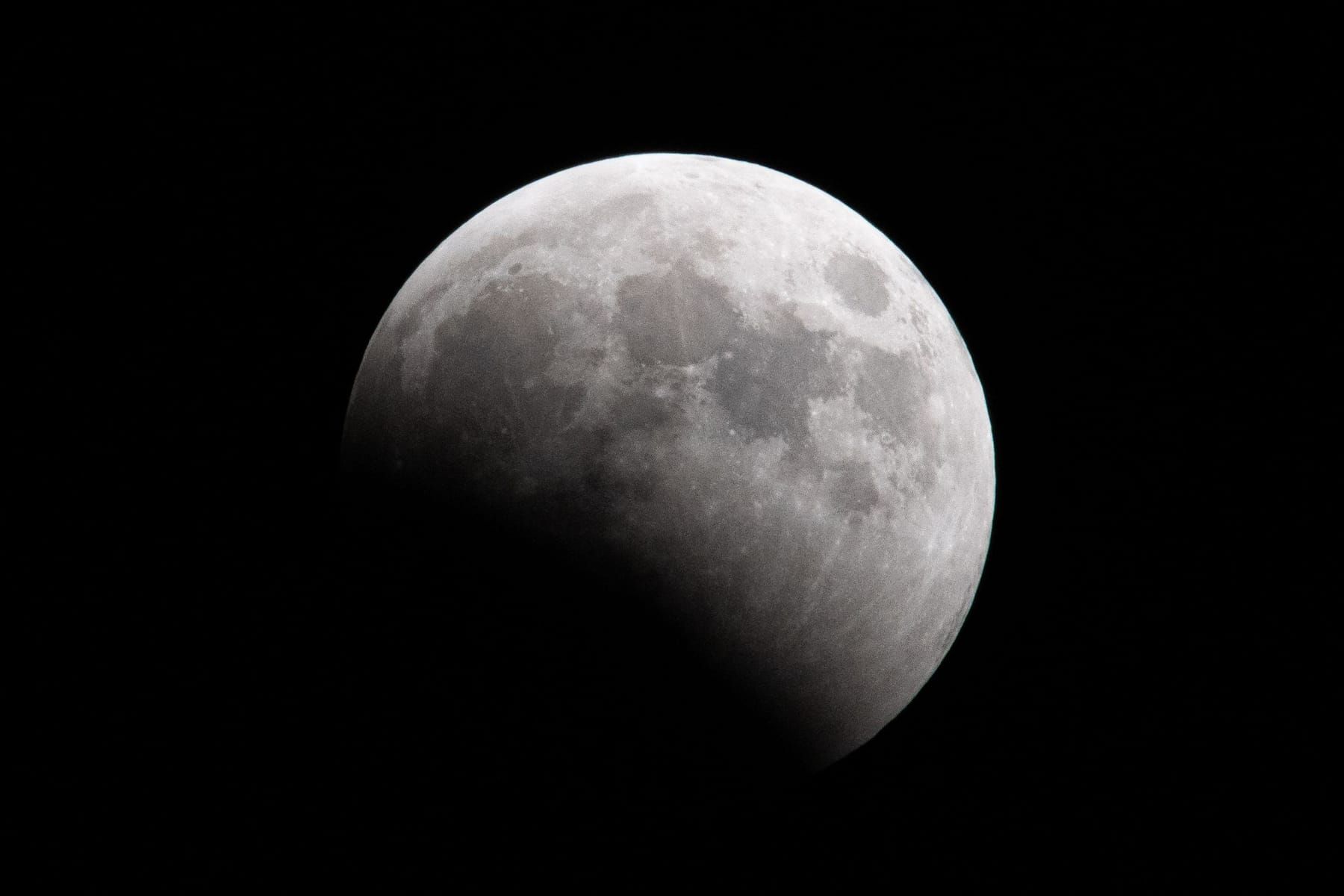
Stages of the eclipse
| Stage | Time in UTC |
|---|---|
| Penumbral eclipse begins | February 20, 21:12 |
| Maximum | February 20, 23:13 |
| Penumbral eclipse ends | February 21, 01:14 |
Where the eclipse can be seen
Visibility depends on whether the Moon is above the horizon. The central phase is the partial and total part of the eclipse (the whole eclipse for a penumbral one).
At your location
| Stage | Time | Moon altitude |
|---|---|---|
| Penumbral eclipse begins | 4:12 PM | -14° |
| Maximum | 6:13 PM | 6° |
| Penumbral eclipse ends | 8:14 PM | 28° |
The Moon rises during the eclipse.
Local times (America/New York).
Local times in cities
Local time of the maximum and the height of the Moon above the horizon at that moment.
| City | Maximum | Moon altitude | Visibility |
|---|---|---|---|
| Ljubljana | February 21, 00:13 | 53° | Whole eclipse |
| London | February 20, 23:13 | 46° | Whole eclipse |
| Berlin | February 21, 00:13 | 47° | Whole eclipse |
| Madrid | February 21, 00:13 | 55° | Whole eclipse |
| Rome | February 21, 00:13 | 57° | Whole eclipse |
| Istanbul | February 21, 02:13 | 56° | Whole eclipse |
| Reykjavik | February 20, 23:13 | 29° | Whole eclipse |
| New York | February 20, 6:13 PM | 6° | At maximum |
| Chicago | February 20, 5:13 PM | -3° | Partly |
| Los Angeles | February 20, 3:13 PM | -28° | Not visible |
| Honolulu | February 20, 1:13 PM | -58° | Not visible |
| Mexico City | February 20, 17:13 | -19° | Partly |
| Buenos Aires | February 20, 20:13 | 7° | At maximum |
| Cape Town | February 21, 01:13 | 45° | Whole eclipse |
| Dubai | February 21, 03:13 | 48° | Whole eclipse |
| Tokyo | February 21, 08:13 | -21° | Partly |
| Sydney | February 21, 10:13 AM | -44° | Not visible |
More events
- Annular solar eclipse, February 6, 2027
- Penumbral lunar eclipse, July 18, 2027
- Total solar eclipse, August 2, 2027
- Penumbral lunar eclipse, August 17, 2027
- Partial lunar eclipse, January 12, 2028
- Annular solar eclipse, January 26, 2028
- Partial lunar eclipse, July 6, 2028
- Total solar eclipse, July 22, 2028
- Total lunar eclipse, December 31, 2028
- Clocks go back in Europe 2026
- Daylight saving time ends in the US 2026
- December solstice 2026
- Perihelion 2027
- Daylight saving time starts in the US 2027
- March equinox 2027